News and updates on research on livestock value chains by the International Livestock Research Institute and partners

Showing posts with label small ruminants. Show all posts

Friday, July 13, 2012

The imGoats project reflects on use of Outcome Mapping and innovation platforms to improve goat value chains

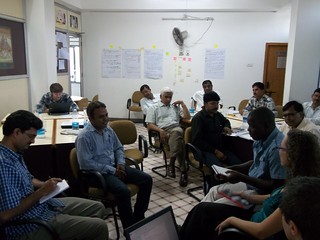
Group discussions at the imGoats project learning and reflection workshop
Group discussions at the imGoats project learning and reflection workshop, Udaipur, India, 2-6 July 2012 (photo credit: ILRI/Tezira Lore).

The imGoats project seeks to investigate how best goat value chains can be used to increase food security and reduce poverty among smallholders in semi-arid regions in India and Mozambique.

On 2-6 July 2012, the project teams from both countries met in Udaipur, India to take part in a learning and reflection workshop on the activities achieved so far and the work still remaining.

The five-day, intensive workshop gave the participants ample opportunity to discuss and share progress achieved by the teams in Rajasthan and Jharkhand in India and Vilanculos in Mozambique in order to learn from each other's experiences in using Outcome Mapping and innovation platforms to improve the functioning of goat value chains.

In addition, the teams were able to review their communication plans and refine their strategies towards identifying the communication outputs to be produced and activities to be undertaken in the final six months of the project.

"The agenda of the workshop was very dense but it is heartening to see that all the teams have made good progress. Outcome Mapping has helped us to adapt our planning and improve our work. The session on innovation platforms was useful for sharing experiences and frustrations, too, and how to overcome these," said imGoats project coordinator Saskia Hendrickx of the International Livestock Research Institute (ILRI) at the close of the workshop.

"We have six months left and a lot to do but there is a good team spirit and we can make it," Hendrickx added.

For more information about the workshop, check out the session notes on the imGoats wiki or read some reflections by ILRI postdoctoral scientists Birgit Boogard and Ramkumar Bendapudi on their experiences with the use of Outcome Mapping and innovation platforms in India and Mozambique. Also check out the workshop photos on Flickr.


Funded by the European Commission - International Fund for Agricultural Research (IFAD), the imGoats project is led by researchers from ILRI in collaboration with the BAIF Development Research Foundation in India and CARE International in Mozambique. For more information, visit imgoats.org.

Friday, August 12, 2011

Goat value chain actors in India and Mozambique hold innovation platform meetings


Small-scale goat production and marketing are important sources of livelihood for poor livestock keepers in the arid and semi-arid regions of India and Mozambique.

The Market Opportunities theme of the International Livestock Research Institute (ILRI) is leading a project in collaboration with BAIF Development Research Foundation in India and CARE International, Mozambique towards increasing incomes and food security in a sustainable manner by enhancing pro-poor small ruminant value chains in India and Mozambique.

The project Small ruminant value chains as platforms for reducing poverty and increasing food security in India and Mozambique (imGoats in short), which is funded by the International Fund for Agricultural Development (IFAD), got underway in February 2011.

It uses an innovation systems approach aimed at transforming informal subsistence-level goat production to a viable, profitable model while preserving community and national resource systems. In addition to goat keepers, project beneficiaries include small-scale traders and providers of inputs and animal health services.

Project partners in India and Mozambique recently facilitated inaugural innovation platform meetings in Inhassoro, Mozambique (May 2011) and Jhadol, Udaipur, India (July 2011). Innovation platforms offer an opportunity for the different actors in the goat value chain to gather and exchange knowledge and share experiences towards improving goat production and marketing processes for the benefit of all.

During the innovation platform meetings, participants shared the challenges and constraints they face during goat production/marketing and discussed possible solutions and priority areas for action towards addressing the constraints.

For more details about the imGoats project and to read the meeting reports, please visit http://imgoats.org or contact Dr Ranjitha Puskur of ILRI (r.puskur @ cgiar.org).

Monday, March 21, 2011

New project to study goat value chains as platform for boosting food security in India and Mozambique

A woman herds her goats in Rajasthan, India. New project targets goat value chains as pathways out of poverty for small-scale goat keepers in India and Mozambique. (Photo credit: ILRI/Mann)

Following a planning workshop in February 2011, a new project on goat value chains is now underway in India and Mozambique to investigate how best these value chains can be used to increase food security and reduce poverty among smallholders.


The main target groups are poor goat keepers, especially women, and other marginalized groups like scheduled castes and tribes in India; households living with HIV/AIDS and female-headed households in Mozambique. These include small-scale agropastoralists who cultivate small plots of land, as well as the landless.


The project, Small ruminant value chains as platforms for reducing poverty and increasing food security in India and Mozambique (imGoats), is led by researchers from the Market Opportunities theme of the International Livestock Research Institute (ILRI) in collaboration with the BAIF Development Research Foundation in India and CARE International, Mozambique. It is funded by the International Fund for Agricultural Development (IFAD).

Download the project brochure in English (Small ruminant value chains to reduce poverty and increase food security in India and Mozambique)

Download the project brochure in Portuguese (Cadeias de valor de caprinos como plataformas para reduzira pobreza e aumentar a segurança alimentar em zonas semi-áridas da Índia e Moçambique)

For more information, please email Dr Ranjitha Puskur at r.puskur @ cgiar.org

Thursday, June 17, 2010

New journal article: Consumer demand for sheep and goat meat in Kenya


A recently published study on consumer demand for sheep and goat meat in Kenya has found that a niche market exists for these products among consumers in two key production and market locations in the country.

The study, published in an article in the May 2010 issue of Small Ruminant Research, sought to investigate patterns of consumption of small ruminants' meat in Kenya and the factors influencing consumer demand for these products.

Data from 103 households were collected in Marsabit  District, a semi-arid region where small ruminant production is a major economic activity, and Kiamaiko area in the capital city Nairobi, a key market for sheep and goats from Marsabit.

Over 55 per cent of sampled households preferred sheep and goat meat over beef. Purchase price of small ruminant meat, household location, and share of monthly income spent on food were among the factors identified to play a role in influencing consumer demand for sheep and goat meat.

Producers need to be aware of the existing and potential demand for sheep and goat meat so as to be able to respond appropriately to consumers' needs and ensure access to markets, the authors conclude.

Dr Isabelle Baltenweck, an agricultural economist with ILRI's Market Opportunities theme, is a co-author of the journal article.

Read the abstract here.

Citation
Juma GP, Ngigi M, Baltenweck I and Drucker AG. 2010. Consumer demand for sheep and goat meat in Kenya. Small Ruminant Research 90(1-3): 135-138.

Monday, November 30, 2009

ILRI research report: Constraints in the market chains for export of Sudanese sheep and sheep meat to the Middle East


Livestock exports are the second most important source of foreign exchange in Sudan after oil. The Middle East, especially Saudi Arabia, has been the traditional export destination for Sudan’s livestock and livestock products.

However, while these Middle Eastern markets have a specific preference for mutton from Sudan's natural grass-fed sheep, competition from new markets like Australia, Brazil and New Zealand coupled with constraints within the supply chains for sheep and sheep meat have set Sudan's market share on a downward trend.

Research by ILRI and partners from Sudan's Ministry of Animal Resources and Fisheries, and the University of Khartoum was carried out to characterize the nature of these market constraints.

The study findings are contained in a report titled Constraints in the market chains for export of Sudanese sheep and sheep meat to the Middle East.

Distant supply hinterlands, poor road networks, low market offtake rates, poor access to animal health facilities and deficient quality assurance systems were identified as the main market barriers.

The authors make several recommendations for improving the efficiency of the market chain and for future research. These include branding and promotion of Sudanese sheep and mutton; more rigorous application of animal/meat inspection and certification; and increased access to credit for livestock keepers.

Access the report

Citation
el Dirani OH, Jabbar MA and Babiker IB. 2009. Constraints in the market chains for export of sheep and sheep meat to the Middle East. Research Report No. 16. Department of Agricultural Economics, University of Khartoum, Khartoum, the Sudan and ILRI (International Livestock Research Institute), Nairobi, Kenya. 93 pp.