News and updates on research on livestock value chains by the International Livestock Research Institute and partners

Thursday, June 17, 2010

New journal article: Predictive model developed to improve rinderpest control in Somalia

A newly developed predictive model shows potential to improve surveillance and control of rinderpest in central and southern Somalia.

The model combines spatial and network factors to identify point locations and areas with high risk of presence of rinderpest. These are then used to generate a risk map that can help in prioritizing disease surveillance and control activities. This is particularly important in Somalia where veterinary resources are scarce.

In addition to improving surveillance efforts for rinderpest, the integration of spatial and network parameters in the model allows for its application to other livestock species (such as sheep, goats and camels) and diseases in nomadic pastoral systems.

The development of this new model is described in a journal article published in the May 2010 issue of the open access journal BMC Veterinary Research.

The article is based on research carried out within the framework of the Improvement and Diversification of Somali Livestock Trade and Marketing project implemented by ILRI and Terra Nuova. Tom Otieno, formerly with the ILRI Market Opportunities theme, is a co-author.

Read the article here

Citation
Ortiz-Pelaez A, Pfeiffer DU, Tempia S, Otieno FT, Aden HH and Costagli R. 2010. Risk mapping of rinderpest sero-prevalence in central and southern Somalia based on spatial and network risk factors. BMC Veterinary Research 6:22.

Friday, June 04, 2010

Innovation platforms boost livestock value chains in Mozambique

A novel approach to enhancing livestock commercialization is helping to improve market participation by smallholder livestock keepers in semi-arid Mozambique.

The Innovation Platform (IP) approach uses value chain analysis to identify challenges and constraints to livestock production and marketing. Based on these, opportunities to overcome the bottlenecks are then sought.

By collectively engaging all value chain actors, the IP approach strengthens linkages among sector stakeholders thus helping to enhance efficiency through better alignment of livestock production and market requirements. In addition, improved flow of market information results in reduced transaction costs and greater market efficiency.

The Livestock and Livelihoods (LILI) project (Livestock and Livelihoods: Improving market participation of small-scale livestock producers), implemented from 2007, used the IP approach to contribute towards achieving the project's objectives.

These objectives were to: (1) improve market participation of small-scale goat and cattle keepers in semi-arid regions of Mozambique, Namibia and Zimbabwe; (2) evaluate constraints to and opportunities for commercialization of smallholder production of goats and cattle; (3) test and evaluate alternative livestock marketing and input delivery systems; (4) assess the impact of market-led technology change on household incomes; and (5) establish an effective communication strategy to facilitate networking and exchange of information among sector stakeholders.

The LILI project was collaboratively undertaken by the International Crops Research Institute for Semi-Arid Tropics (ICRISAT), the International Livestock Research Institute (ILRI), the National Agricultural Research Institute of Mozambique (IIAM), the Matopos Research Station of Zimbabwe and the Namibian National Farmers' Union (NNFU). 

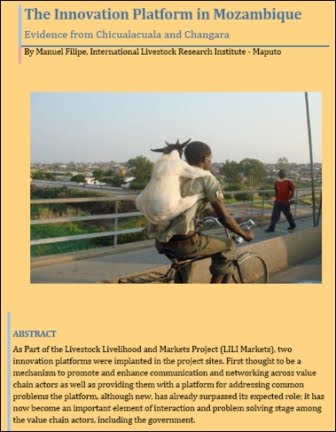
Some of the experiences of implementing the IP approach in the LILI project are documented in an April 2010 report, The innovation platform in Mozambique: Evidence from Chicualacuala and Changara, by Dr Manuel Filipe, a scientist formerly with ILRI's Market Opportunities research theme.

"The Innovation Platform can be a platform for constructive debate and problem solving," Dr Filipe notes in his report. "The market actors as well as the local authorities have embraced it and it is being used as an entry point for other initiatives such as training and planning, among others," he adds.

The LILI project was funded by the European Union and supported by the Southern African Development Community.

Download the report

Citation
Filipe M. 2010. The innovation platform in Mozambique: Evidence from Chicualacuala and Changara. Project report. ILRI (International Livestock Research Institute), Nairobi. 18pp.


Monday, May 24, 2010

Counting the losses: Regional project quantifies milk spoilage in East Africa

A regional dairy industry development project is generating research data to quantify the levels of milk losses due to spoilage in East Africa. The East Africa Dairy Development project (EADD) is involved in research to assess the levels and causes of milk spoilage experienced by informal milk traders in Kenya, Rwanda and Uganda. The analysis of the data collected will be used as an empirical basis for interventions aimed at reducing losses and improving milk quality in the informal dairy sector of the respective countries.

Preliminary results show that over 75% of traders sourcing milk from farmers report milk loss due to spoilage, and those losing milk report losses of between 17 and 23 litres per week due to spoilage, occasioned largely by unhygienic milk handling and inadequate milk cooling systems. Other causes of milk spoilage include adulteration and mixing of evening and morning milk. Factors that exacerbate the problem are delayed milk delivery, erratic electricity supply at milk cooling plants and low levels of training on hygienic milk handling among traders. Data analysis is ongoing to evaluate the losses in income experienced by farmers and informal milk traders as a result of milk spoilage.

The data generated by EADD builds on findings from an earlier study by the Food and Agriculture Organization of the United Nations (FAO) in 2003-04. At the time, the problem of milk losses had long been acknowledged to exist in Eastern Africa. However, there was a gap in knowledge with regard to the quantities of milk lost along the producer-to-consumer supply chain. To fill this gap, FAO led rapid appraisal studies aimed at quantifying post-harvest milk and dairy product losses in Eastern Africa and the Near East.

The studies carried out in Ethiopia, Kenya, Syria, Tanzania and Uganda represented the first-ever systematic attempt to accurately quantify milk losses in these countries. The country reports formed the basis of two synthesis reports prepared by the International Livestock Research Institute (ILRI) that identified the types, levels and causes of milk losses, both in terms of quantity and monetary value. Specific links in the milk supply chain where significant losses were experienced were also identified. Losses with pragmatic solutions were identified and targeted for appropriate interventions aimed at reducing or eliminating the losses.

In Eastern Africa, the small-scale informal dairy sector was found to bear the brunt of post-harvest milk losses; formal milk processors incurred minimal losses. In terms of quantity, significant milk losses were found to occur at the farm level (8.4, 28.6, 46.4 and 54.2 million litres of milk per year for Uganda, Ethiopia, Tanzania and Kenya, respectively) valued at between 0.9 and 11 million US dollars.


Post-harvest losses of milk at the farm represented 1.3 to 6.4 percent of the value of available milk at the farm level. The total value of post-harvest milk losses per year amounted to 9.9, 14.2, 17.8 and 23.9 million US dollars for Tanzania, Ethiopia, Kenya and Uganda, respectively.

Poor road infrastructure and inadequate markets for raw milk were the main causes of farm-level losses, which were found to be largely in form of spoilage, spillage and “forced home consumption” (including by calves and humans) over and above normal household consumption. Although in quantity terms forced losses may seem to be high, in value terms they are less significant, because an estimated 70% of the value of the milk is still captured. Along the marketing chain, milk loss was mainly due to spillage and spoilage. These losses were occasioned by poor access to markets, poor milk handling practices and irregular power supply in milk processing plants.

EADD has identified the lack of training in milk hygiene as an opportunity to improve the quality of milk sold by the informal dairy sector through implementation of a quality assurance scheme that incorporates training and certification of traders. The project is also assisting farmers to own chilling plants through Dairy Farmers Business Associations to reduce the losses and increase marketed output.

EADD is implemented by Heifer International in partnership with African Breeders Service Total Cattle Management (ABS-TCM), ILRI, TechnoServe and the World Agroforestry Centre (ICRAF). Funded by the Bill & Melinda Gates Foundation, the goal of this project is to help one million people – 179,000 families living on small 1-5 acre farms – lift themselves out of poverty through more profitable production and marketing of milk.

For more information about EADD, please visit the project website http://www.heifer.org/eadd.

This article was written by Tezira Lore with input from Amos Omore

Monday, April 26, 2010

New journal article: Testing of trypanosomosis control strategies in West Africa's cotton zone

Widespread resistance to trypanocidal drugs threatens their effective use by smallholder crop-livestock farmers, particularly in the cotton zone of West Africa where the risk of trypanosomosis is high.

Research to identify and test best-bet integrated control strategies to reduce the risk of trypanocide resistance found that community-based tse tse control is effective but needs external support to be sustainable.

Rational drug use is a promising strategy in areas where resistance is not yet well established. Keeping of trypanotolerant cattle, though less attractive to farmers, should be promoted in areas where these cattle are still maintained.

These research findings are discussed in an article published online on 23 April 2010 in a special  issue of the journal Transboundary and Emerging Diseases. ILRI researchers Hippolyte Affognon, Oumar Diall, Delia Grace and Thomas Randolph are co-authors.

Read the abstract here

Citation
Clausen P-H, Bauer B, Zessin K-H, Diall O, Bocoum Z, Sidibe I, Affognon H, Waibel H, Grace D and Randolph T. 2010. Preventing and containing trypanocide resistance in the cotton zone of West Africa. Transboundary and Emerging Diseases 57(1-2): 28-32.

Wednesday, March 31, 2010

Fodder Innovation Project featured in Farming Matters magazine


The March 2010 issue of the quarterly magazine Farming Matters (formerly known as Leisa Magazine) features an article on the Fodder Innovation Project which is led by ILRI's Market Opportunities theme.

This action-research project is aimed at enabling effective innovation in institutional and policy arenas to address the problem of fodder scarcity, alongside the conventional technology-related approaches to improving the quality and availability of fodder.

The project is being implemented in India and Nigeria in collaboration with the United Nations University (UNU-MERIT), the International Crops Research Institute for the Semi-Arid Tropics (ICRISAT) and the International Institute of Tropical Agriculture (IITA). It is funded by the UK Department for International Development (DFID).

Here is the link to the article, Re-assessing the fodder problem.

Friday, February 26, 2010

Vietnam pork sector study featured in New Agriculturist

A collaborative study led by ILRI's Markets Opportunities theme to map the supply chains for pigs and pork products in Vietnam is featured in the January 2010 issue of the online bimonthly newsletter New Agriculturist.

The project, Improving the competitiveness of pig producers in an adjusting Vietnam marketis aimed at generating research evidence to inform policymakers on the appropriate policy, technological and institutional frameworks that will allow Vietnam's smallholder pig producers to competitively increase their incomes through enhanced access to market chains for high-value pork products.

"Smallholders could play a much greater role in pork production but there is a need to generate appropriate technologies to maximize the potential of these systems, to improve the breeds and to provide better and more cost-efficient feed rations," the article quotes Lucy Lapar, a scientist with ILRI's Market Opportunities theme scientist and the coordinator of the project.

The project is due to end in March 2010 but it is hoped that the outputs of the study will be taken up by policymakers and sector stakeholders to inform dialogue towards formulation of pro-poor policies in support of Vietnam's smallholder pig producers.

The project is funded by the Australian Centre for International Agricultural Research (ACIAR) in collaboration with the Centre for Agricultural Policy - Institute of Policy and Strategy for Agricultural and Rural Development (CAP-IPSARD), the International Food Policy Research Institute (IFPRI), Oxfam and the University of Queensland.

Here's the link to the New Agriculturist article, Vietnam: taking a pig to market.

Wednesday, February 10, 2010

Blog launched: Participatory Epidemiology Network for Animal and Public Health


The Participatory Epidemiology Network for Animal and Public Health (PENAPH) has launched a blog to share news, training materials and other useful resources related to its work.

Started in 2007, PENAPH connects groups and individuals who apply participatory epidemiology methods in the control of emerging and existing diseases. PENAPH works to improve livelihoods by contributing to solve the world's most pressing health challenges.

PENAPH's partner institutions have a wealth of experience in participatory epidemiology and participatory disease surveillance, as well as interests in promoting One Health approaches. These partners are:
  • African Union-Interafrican Bureau for Animal Resources (AU-IBAR)
  • Food and Agriculture Organization of the United Nations (FAO)
  • International Livestock Research Institute (ILRI)
  • Royal Veterinary College, University of London (RVC)
  • Vétérinaires Sans Frontières - Belgium (VSF-B)
  • Veterinarians Without Borders - Canada (VSF-C)
  • World Organization for Animal Health (OIE)

To find out more about PENAPH, please visit the blog at http://penaph.net.