News and updates on research on livestock value chains by the International Livestock Research Institute and partners

Wednesday, July 14, 2010

Pan-African conference to feature special session on livestock trade

A special session on livestock trade and markets will feature at a pan-African conference on animal agriculture to be held in October 2010 in Ethiopia.

ILRI's Markets Theme scientist Berhanu Gebremedhin is organizing a special session titled Livestock trade and markets: leveling the national, regional and international policy playing fields for poverty impact for the 5th All Africa Conference of Animal Agriculture (AACAA).

The theme of the conference is Commercialization of livestock agriculture: Challenges and opportunities. It is set to be held on 25-28 October 2010 at the United Nations Conference Centre in Addis Ababa, Ethiopia.

The AACAA is held every five years. This year's event is organized by the All Africa Society for Animal Production in conjunction with the Ethiopian Society of Animal Production.

For more information about the conference, please email the Organizing Officer, Feven Tadesse on aasap.feven @ mail.com.

Tuesday, July 13, 2010

New Agriculturist features Fodder Innovation Project

The July 2010 issue of the online magazine New Agriculturist features the Fodder Innovation Project which is using an innovation systems approach to reposition research towards a focus on building alliances and networks that strengthen innovation processes.

The project is being implemented in India and Nigeria in collaboration with the United Nations University (UNU-MERIT), the International Crops Research Institute for the Semi-Arid Tropics (ICRISAT) and the International Institute of Tropical Agriculture (IITA). It is funded by the UK Department for International Development (DFID).

Here is the link to the article, Learning for change: a logical approach for fodder innovation?

Thursday, July 08, 2010

Are smallholder dairy farmers in East Africa competitive?

Small-scale dairy farms dominate production in most developing countries, including in East Africa. In the light of rapidly increasing demand for milk in most of the developing world, one important question is: can small-scale dairy farmers compete in the international arena? Also, what factors influence their competitiveness?

These questions were explored recently during a presentation by ILRI agricultural economist, Dr Isabelle Baltenweck, at the 6th Africa Dairy Conference and Exhibition held in Kigali, Rwanda on 18-20 May 2010.

The presentation was based on research findings from the East Africa Dairy Development project which quantified farm-gate milk prices and costs of milk production in study sites in Kenya, Rwanda and Uganda.

The findings indicate that smallholder dairy producers in East Africa can effectively compete, mainly due to strong local demand. This can be further enhanced by improving economies of scale; enhancing access to inputs, services and appropriate technologies; improving infrastructure; and creating an enabling policy and institutional environment.

Thursday, June 17, 2010

New journal article: Consumer demand for sheep and goat meat in Kenya


A recently published study on consumer demand for sheep and goat meat in Kenya has found that a niche market exists for these products among consumers in two key production and market locations in the country.

The study, published in an article in the May 2010 issue of Small Ruminant Research, sought to investigate patterns of consumption of small ruminants' meat in Kenya and the factors influencing consumer demand for these products.

Data from 103 households were collected in Marsabit  District, a semi-arid region where small ruminant production is a major economic activity, and Kiamaiko area in the capital city Nairobi, a key market for sheep and goats from Marsabit.

Over 55 per cent of sampled households preferred sheep and goat meat over beef. Purchase price of small ruminant meat, household location, and share of monthly income spent on food were among the factors identified to play a role in influencing consumer demand for sheep and goat meat.

Producers need to be aware of the existing and potential demand for sheep and goat meat so as to be able to respond appropriately to consumers' needs and ensure access to markets, the authors conclude.

Dr Isabelle Baltenweck, an agricultural economist with ILRI's Market Opportunities theme, is a co-author of the journal article.

Read the abstract here.

Citation
Juma GP, Ngigi M, Baltenweck I and Drucker AG. 2010. Consumer demand for sheep and goat meat in Kenya. Small Ruminant Research 90(1-3): 135-138.

New journal article: Predictive model developed to improve rinderpest control in Somalia

A newly developed predictive model shows potential to improve surveillance and control of rinderpest in central and southern Somalia.

The model combines spatial and network factors to identify point locations and areas with high risk of presence of rinderpest. These are then used to generate a risk map that can help in prioritizing disease surveillance and control activities. This is particularly important in Somalia where veterinary resources are scarce.

In addition to improving surveillance efforts for rinderpest, the integration of spatial and network parameters in the model allows for its application to other livestock species (such as sheep, goats and camels) and diseases in nomadic pastoral systems.

The development of this new model is described in a journal article published in the May 2010 issue of the open access journal BMC Veterinary Research.

The article is based on research carried out within the framework of the Improvement and Diversification of Somali Livestock Trade and Marketing project implemented by ILRI and Terra Nuova. Tom Otieno, formerly with the ILRI Market Opportunities theme, is a co-author.

Read the article here

Citation
Ortiz-Pelaez A, Pfeiffer DU, Tempia S, Otieno FT, Aden HH and Costagli R. 2010. Risk mapping of rinderpest sero-prevalence in central and southern Somalia based on spatial and network risk factors. BMC Veterinary Research 6:22.

Friday, June 04, 2010

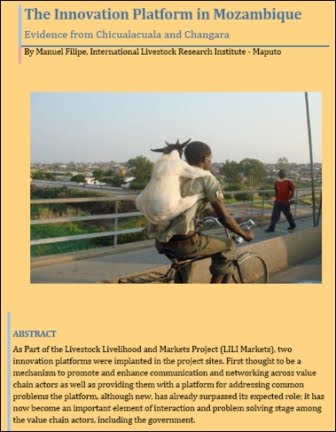
Innovation platforms boost livestock value chains in Mozambique

A novel approach to enhancing livestock commercialization is helping to improve market participation by smallholder livestock keepers in semi-arid Mozambique.

The Innovation Platform (IP) approach uses value chain analysis to identify challenges and constraints to livestock production and marketing. Based on these, opportunities to overcome the bottlenecks are then sought.

By collectively engaging all value chain actors, the IP approach strengthens linkages among sector stakeholders thus helping to enhance efficiency through better alignment of livestock production and market requirements. In addition, improved flow of market information results in reduced transaction costs and greater market efficiency.

The Livestock and Livelihoods (LILI) project (Livestock and Livelihoods: Improving market participation of small-scale livestock producers), implemented from 2007, used the IP approach to contribute towards achieving the project's objectives.

These objectives were to: (1) improve market participation of small-scale goat and cattle keepers in semi-arid regions of Mozambique, Namibia and Zimbabwe; (2) evaluate constraints to and opportunities for commercialization of smallholder production of goats and cattle; (3) test and evaluate alternative livestock marketing and input delivery systems; (4) assess the impact of market-led technology change on household incomes; and (5) establish an effective communication strategy to facilitate networking and exchange of information among sector stakeholders.

The LILI project was collaboratively undertaken by the International Crops Research Institute for Semi-Arid Tropics (ICRISAT), the International Livestock Research Institute (ILRI), the National Agricultural Research Institute of Mozambique (IIAM), the Matopos Research Station of Zimbabwe and the Namibian National Farmers' Union (NNFU). 

Some of the experiences of implementing the IP approach in the LILI project are documented in an April 2010 report, The innovation platform in Mozambique: Evidence from Chicualacuala and Changara, by Dr Manuel Filipe, a scientist formerly with ILRI's Market Opportunities research theme.

"The Innovation Platform can be a platform for constructive debate and problem solving," Dr Filipe notes in his report. "The market actors as well as the local authorities have embraced it and it is being used as an entry point for other initiatives such as training and planning, among others," he adds.

The LILI project was funded by the European Union and supported by the Southern African Development Community.

Download the report

Citation
Filipe M. 2010. The innovation platform in Mozambique: Evidence from Chicualacuala and Changara. Project report. ILRI (International Livestock Research Institute), Nairobi. 18pp.


Monday, May 24, 2010

Counting the losses: Regional project quantifies milk spoilage in East Africa

A regional dairy industry development project is generating research data to quantify the levels of milk losses due to spoilage in East Africa. The East Africa Dairy Development project (EADD) is involved in research to assess the levels and causes of milk spoilage experienced by informal milk traders in Kenya, Rwanda and Uganda. The analysis of the data collected will be used as an empirical basis for interventions aimed at reducing losses and improving milk quality in the informal dairy sector of the respective countries.

Preliminary results show that over 75% of traders sourcing milk from farmers report milk loss due to spoilage, and those losing milk report losses of between 17 and 23 litres per week due to spoilage, occasioned largely by unhygienic milk handling and inadequate milk cooling systems. Other causes of milk spoilage include adulteration and mixing of evening and morning milk. Factors that exacerbate the problem are delayed milk delivery, erratic electricity supply at milk cooling plants and low levels of training on hygienic milk handling among traders. Data analysis is ongoing to evaluate the losses in income experienced by farmers and informal milk traders as a result of milk spoilage.

The data generated by EADD builds on findings from an earlier study by the Food and Agriculture Organization of the United Nations (FAO) in 2003-04. At the time, the problem of milk losses had long been acknowledged to exist in Eastern Africa. However, there was a gap in knowledge with regard to the quantities of milk lost along the producer-to-consumer supply chain. To fill this gap, FAO led rapid appraisal studies aimed at quantifying post-harvest milk and dairy product losses in Eastern Africa and the Near East.

The studies carried out in Ethiopia, Kenya, Syria, Tanzania and Uganda represented the first-ever systematic attempt to accurately quantify milk losses in these countries. The country reports formed the basis of two synthesis reports prepared by the International Livestock Research Institute (ILRI) that identified the types, levels and causes of milk losses, both in terms of quantity and monetary value. Specific links in the milk supply chain where significant losses were experienced were also identified. Losses with pragmatic solutions were identified and targeted for appropriate interventions aimed at reducing or eliminating the losses.

In Eastern Africa, the small-scale informal dairy sector was found to bear the brunt of post-harvest milk losses; formal milk processors incurred minimal losses. In terms of quantity, significant milk losses were found to occur at the farm level (8.4, 28.6, 46.4 and 54.2 million litres of milk per year for Uganda, Ethiopia, Tanzania and Kenya, respectively) valued at between 0.9 and 11 million US dollars.


Post-harvest losses of milk at the farm represented 1.3 to 6.4 percent of the value of available milk at the farm level. The total value of post-harvest milk losses per year amounted to 9.9, 14.2, 17.8 and 23.9 million US dollars for Tanzania, Ethiopia, Kenya and Uganda, respectively.

Poor road infrastructure and inadequate markets for raw milk were the main causes of farm-level losses, which were found to be largely in form of spoilage, spillage and “forced home consumption” (including by calves and humans) over and above normal household consumption. Although in quantity terms forced losses may seem to be high, in value terms they are less significant, because an estimated 70% of the value of the milk is still captured. Along the marketing chain, milk loss was mainly due to spillage and spoilage. These losses were occasioned by poor access to markets, poor milk handling practices and irregular power supply in milk processing plants.

EADD has identified the lack of training in milk hygiene as an opportunity to improve the quality of milk sold by the informal dairy sector through implementation of a quality assurance scheme that incorporates training and certification of traders. The project is also assisting farmers to own chilling plants through Dairy Farmers Business Associations to reduce the losses and increase marketed output.

EADD is implemented by Heifer International in partnership with African Breeders Service Total Cattle Management (ABS-TCM), ILRI, TechnoServe and the World Agroforestry Centre (ICRAF). Funded by the Bill & Melinda Gates Foundation, the goal of this project is to help one million people – 179,000 families living on small 1-5 acre farms – lift themselves out of poverty through more profitable production and marketing of milk.

For more information about EADD, please visit the project website http://www.heifer.org/eadd.

This article was written by Tezira Lore with input from Amos Omore