News and updates on research on livestock value chains by the International Livestock Research Institute and partners

Tuesday, November 27, 2012

East Africa Dairy Development project unveils new-look website


Screen capture of the new website of the East Africa Dairy Development project. Check it out at www.heifer.org/eadd.
The website of the East Africa Dairy Development project has been redesigned and migrated to a new micro-site hosted by Heifer International, the institution that leads this collaborative project. The project's new web address is http://www.heifer.org/eadd.

The original web address, www.eadairy.org, will now redirect to the new address and no longer to the Wordpress site, http://eadairy.wordpress.com. Updates will no longer be published on the Wordpress site.

Please make note of this change and update your bookmarks accordingly so that you remain up to date with project news and updates.


About the East Africa Dairy Development project
The East Africa Dairy Development project is a regional industry development program implemented by Heifer International in partnership with the African Breeders Services Total Cattle Management, the International Livestock Research Institute, TechnoServe and the World Agroforestry Centre

The project is funded by the Bill & Melinda Gates Foundation as part of an agricultural development grant designed to boost the yields and incomes of millions of small farmers in Africa and other parts of the developing world so they can lift themselves and their families out of hunger and poverty.

The vision of success for the  project is that the lives of 179,000 families – or approximately one million people – are transformed by doubling household dairy income by the tenth year through integrated intervention in dairy production, market access and knowledge application.

Monday, November 26, 2012

ILRI presents at the Ecohealth 2012 conference

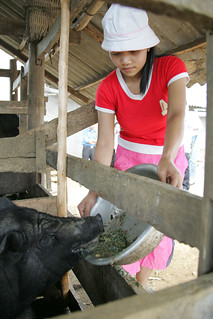
Smallholder pig production in northern Viet Nam
Farmer Ma Thi Puong feeds her pigs on her farm near the northern town of Mieu Vac, Vietnam. Recent studies show that Ecohealth approaches are useful in assessing the prevalence of emerging zoonotic diseases in Vietnam (photo credit: ILRI/Stevie Mann).

EcoHealth is an emerging, multi-disciplinary field of study that examines how ecosystem changes affect human health so as to prevent new diseases from emerging.

International experts in this field met in Kunming, China from 15 to 18 October 2012 for the 4th biennial conference of the International Association for Ecology and Health (Ecohealth 2012). The theme of the conference was "Sustaining Ecosystems, Supporting Health".

The International Livestock Research Institute (ILRI) was represented at Ecohealth 2012 by a team of scientists working on food safety, zoonoses and emerging infectious diseases in the Southeast Asia region. Below are links to a selection of their presentations:

Applying participatory approach to study zoonoses in provinces of South Vietnam: Experiences and lessons learned

Ecohealth approaches in prevention of emerging and re-emerging zoonotic diseases in southern Vietnam: A retrospective study 2008-2011

Ecosystem approaches to the better management of zoonotic emerging infectious diseases in Southeast Asia (EcoZD): Inputs, throughputs and outputs

Field building leadership initiative: Advancing Ecohealth in Southeast Asia

Framing the problem of emerging zoonotic disease risk using a One Health approach

Hygienic practices and microbial contamination of small-scale poultry slaughterhouses in peri-urban areas, Hanoi, Vietnam

Mapping the interface of poverty, emerging markets and zoonoses

South East Asia One Health University Network (SEAOHUN): Lessons learned

Strategies for adopting EcoHealth theory and practice: Lessons from action‐research on zoonotic diseases in Southeast Asia

Wednesday, November 14, 2012

Good livestock management by all value chain actors can improve quality in the Ethiopian leather industry


Jean Joseph (Jo) CadilhonJo Cadilhon (left) recently joined the International Livestock Research Institute as an agricultural economist with the Changing Demand and Market Institutions team. From 6-9 November 2012, he was among several scientists and other agricultural stakeholders who took part in an international conference organized by CTA in Addis Ababa, Ethiopia under the theme “Making the connection: Value chains for transforming smallholder agriculture”. He facilitated a session on capacity building in value chains and later during one of the conference field trips learned about an important value chain for livestock by-products: the Ethiopian leather industry. Below is his report.

The International Livestock Research Institute (ILRI) was a partner organizer of the CTA conference on Making the connection: value chains for transforming smallholder agriculture held from 6 to 9 November 2012 in Addis Ababa, Ethiopia.

One of the conference field trips organized by the United Nations Industrial Development Organization (UNIDO) focused on leather products so I joined it to discover this value chain for livestock by-products.

I learned that good management practices by all stakeholders in the chain are just as critical for the quality improvement of livestock by-products as it is for the quality and safety of food products derived from livestock.

Take the example of the leather industry in Ethiopia. Although selling animal hides for leather production is only a by-product for livestock producers, the local tanning industry can process up to 30,000 skins per day, producing leather for shoes and garments and creating significant employment, according to the Leather Industry Development Institute.
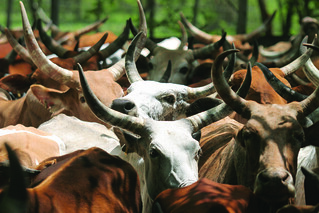
Cattle being watered at the Ghibe River in southwestern Ethiopia
Cattle being watered at the Ghibe River in southwestern Ethiopia. Simple improvements in the practices of livestock value chain stakeholders, such as avoiding inflicting wounds on the skin of cattle during herding, could help improve the quality of Ethiopian leather goods. (photo credit: ILRI/Stevie Mann).

Crucially, simple improvements in herding, slaughtering, skinning and marketing practices in livestock value chains could help improve the quality of finished leather goods and thus increase the incomes for all value chain stakeholders.

For example, men’s shoes are cut out of cow skins. The various components of the shoes are cut from different areas of the skin: the shoulder and butt being stronger and of better quality than the skin from the belly and legs.

The job of the leather cutter is to optimize the number of shoe parts that can be cut out of one hide. If there are holes in the hide due to putrefaction of the skin before tanning, this decreases the number of shoe parts that can be cut out of one hide.

These holes are due to infected wounds in the skin. These wounds are usually inflicted on the animal during herding, slaughtering and skinning of the slaughtered animal.

Furthermore, there are usually several days before a hide reaches the tannery from the slaughterhouse through a very long chain of intermediary traders whereas the optimal time to preserve the quality of animal hides before tanning is just 24 hours.

This long time lag increases the likelihood of putrefaction of any wounds on the hides, thus decreasing the quality of the leather.

One indicator of leather quality is the homogeneity of the leather’s surface. When the live animal has been sick or infected by parasites scars and spots can appear on the skin, which then lead to stains and scars on the tanned leather.

The leather cutters and cobblers then have to work around these defects for fear of seeing the price of the final product depreciated.

Quality improvement in the Ethiopian livestock and leather industry is supported by ILRI,  the Italian Development Cooperation, the United Nations Development Program (UNDP), UNIDO and the United States Agency for International Development (USAID) through linkages with the Leather Industry Development Institute.

Wednesday, October 31, 2012

New research project aims to improve smallholder livestock production and marketing in Botswana

Goats in Botswana
Goats awaiting sale at a market in Botswana. A new collaborative research project aims to improve smallholder livestock production and marketing in Botswana (photo credit: ILRI).

The smallholder sector produces most of Botswana’s meat and over 70% of the country’s agricultural gross domestic product.

Although past policy and research have focused on the beef export sector, rather little information has been generated on the circumstances and potential of the 80,000 smallholders who own most of the country’s cattle, and the 100,000 households that earn livelihoods from sheep and goats.

This leaves strategies and investments for rural development and livelihood generation without a basis in data and analysis.

For both cattle and small ruminants, more competitive smallholder systems can improve livelihoods.

Several factors constrain the production and marketing of surpluses by smallholders: poor animal health is one example, that is often made worse by the complexities of communal grazing, and by limited access to services.

A new 3-year research project, Competitive smallholder livestock in Botswana, asks the following questions, and engages partners in research industry and government to help answer them:
  • What are the characteristics of smallholder livestock producers in Botswana and what factors constrain their livelihoods?
  • How can livestock-related marketing systems in Botswana be improved for the benefit of smallholders and the rural population?

The project has three objectives:
  • To better define smallholder livestock production systems and to identify the factors affecting the productivity of smallholder livestock producers and assess their competitiveness 
  • To understand and improve conditions for market participation and value addition in markets for livestock, livestock products and inputs
  • To strengthen the capacity of agricultural education and extension

The International Livestock Research Institute (ILRI) is collaborating in this project with the Botswana Institute for Development Policy Analysis and the Botswana Ministry of Agriculture.

The outcomes from the study will be improved and more sustainable livelihoods among smallholder livestock keepers, and increased uptake and use of scientific and economic knowledge by those providing services to smallholders.

The project is funded by the Australian Centre for International Agricultural Research (ACIAR) and runs from 1 September 2012 to 31 August 2015.

For more information, please contact Sirak Bahta (s.bahta @ cgiar.org)

Thursday, October 25, 2012

Innovative feed assessment tool to aid smallholder livestock farmers develop site-specific animal feeding options

ELF team conducts PRA exercise on feed assessment tools
The Ethiopian Livestock Feed project team carries out a participatory rapid appraisal in Godina near Debre Zeit, Ethiopia to test feed assessment tools (photo credit: ILRI/Kara Brown).

Smallholder livestock farmers stand to gain from better animal feeding options, thanks to an innovative tool that improves feed assessment by taking a broader approach to also analyze factors relating to production, marketing and input service provision and how these affect the quality and availability of animal feeds.

Conventional feed assessments normally focus just on the type of feed and how to boost its nutritive value so as to improve livestock productivity.

The new feed assessment tool (FEAST) builds on this by adopting a broader scope that takes into account the entire smallholder farming system.

It also uses rapid appraisals to quickly and systematically assess feed resources and demand within a particular farming system.

Why use FEAST?
  • It uses participatory approaches to draw on the knowledge and experiences of both farmers and researchers.
  • It is site-specific and thus is useful in designing and targeting of feed intervention strategies for a particular location.
  • It enables analysis of the importance of livestock in local livelihoods and the relative importance of feed-related problems that farmers face.
  • It gives an insight into key factors such as labour, input availability, credit, seasonality and markets for products.

The International Livestock Research Institute (ILRI) has been developing FEAST since 2009 and the tool has been tested in South Asia and Africa.

The collaborative East Africa Dairy Development project has used FEAST as an entry point for other feed-related interventions.

ILRI recently showcased FEAST at an exhibition on the sidelines of the 13th Biennial Scientific Conference of the Kenya Agricultural Research Institute (KARI) that was held on 22-26 October 2012 at the KARI Headquarters in Nairobi, Kenya.

Under the theme, Showcasing agricultural products, technologies and innovations, the event featured some 500 exhibitors from all over the country.

The poster below, Developing site specific feed plans using the feed assessment tool (FEAST), gives a summary of how FEAST works, the advantages of using the tool and some sample outputs from the East Africa Dairy Development project.

 
Developing site specific feed plans using the feed assessment tool (FEAST) from ILRI

For more information about FEAST, please contact ILRI feed specialist Bernard Lukuyu (b.lukuyu @ cgiar.org) or visit http://www.ilri.org/feast.

Monday, October 01, 2012

Farmer trainers in western Kenya are key in disseminating farm technologies, new study shows

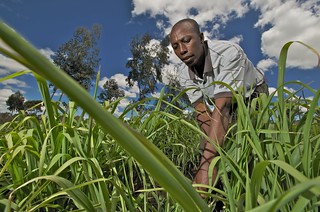
Fodder harvesting
Harvesting fodder on a dairy farm in Kenya. A new study in western Kenya shows that farmer trainers are effective agents in disseminating farm technologies (photo credit: East Africa Dairy Development Project).
Volunteer farmer trainers in western Kenya play important roles in promoting the adoption of agricultural technologies, a new study reports.

In addition, the use of farmer trainers in agricultural extension is a cost-effective method of disseminating technologies to farmers because it is sustainable beyond the lifetime of development projects.

These are among several findings of a study carried out to assess the effectiveness of farmer trainers in disseminating agricultural technologies in western Kenya.

The findings are published in an article in the October 2012 issue of the Journal of Agricultural Education and Extension.

The principal author of the article Ben Lukuyu is a feed scientist at the International Livestock Research Institute (ILRI). The co-authors of the study, which was funded by the East Africa Dairy Development Project, are from the World Agroforestry Centre and the Kenya Forestry Research Institute.

The farmer trainer method of agricultural extension involves farmers sharing their knowledge and experience with other farmers as well as conducting experiments.

Through this participatory approach, a large number of farmers in communities can be reached at low cost through multiplier effects whereby farmers act as the main agents of change and technology adoption in their communities.

The study found that farmer trainers commonly used methods such as farm visits, community gatherings and field days to disseminate information on soil fertility practices, use of crop residues, food crops, vegetables and livestock technologies.

Farmer trainers also played important roles such as mobilizing and training their fellow farmers, hosting demonstration plots and bulking and distributing planting materials.

“The results from the study will be useful to development programs keen on using low-cost, community-based dissemination approaches,” the authors of the paper conclude.

The authors further recommend that the farmer trainer approach be promoted by extension service providers such as governments, non-governmental organizations and the private sector.

However, a cautionary note is sounded that the guidance provided for farmer trainer programs is suited to the conditions existing in western Kenya where the study was carried out and should therefore not be considered as best practices for uptake under general conditions.

Read the abstract of the article

Citation
Lukuyu B, Place F, Franzel S and Kiptot E. 2012. Disseminating improved practices: Are volunteer farmer trainers effective? Journal of Agricultural Education and Extension 18(5): 525-540.

Wednesday, September 19, 2012

New ILRI website features research on agriculture associated diseases

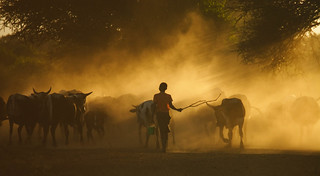
Cattle herded home in the evening in Mozambique
Cattle coming in from the fields in the evening in Lhate Village, Chokwe, Mozambique (photo credit: ILRI/Stevie Mann). 


If you are interested in research on the links between agriculture and health, then check out the new AgHealth website, a web portal on research activities by the International Livestock Research Institute (ILRI) and partners on agriculture-associated diseases.

Prevention and control of agriculture-associated diseases is one of four research components of the collaborative  CGIAR Research Program on Agriculture for Nutrition for Health, which is led by the International Food Policy Research Institute (IFPRI).

The other three components are: value chains for enhanced nutrition; biofortification; and integrated agriculture, nutrition and health programs and policies.

ILRI leads the research component on prevention and control of agriculture-associated diseases, which has over 20 projects under four major research activities:
For more information on ILRI's work on agriculture-associated diseases, please contact the research component leader Delia Grace (d.grace @ cgiar.org).