News and updates on research on livestock value chains by the International Livestock Research Institute and partners

Monday, June 11, 2012

ILRI presents at the 19th World Meat Congress

On 4-6 June 2012, over 300 participants gathered at the Palais des Congrès in Paris, France for the 19th World Meat Congress. The theme of the congress was 'Proudly producing and trading meat'.

Agricultural economist Derek Baker represented the International Livestock Research Institute (ILRI) at the meeting and delivered a presentation titled 'Livestock farming in developing countries: An essential resource'.

Baker is the leader of ILRI's Changing Demand and Market Institutions research team.

Monday, May 28, 2012

New research consortium to provide knowledge for effective One Health approaches to disease control in Africa

Orma Boran cattle crossing a river in Kenya
Orma Boran cattle crossing a river in Kenya. The new Dynamic Drivers of Disease Consortium will integrate understanding of zoonoses, ecosystems and wellbeing (photo credit: ILRI/Dolan).
Dynamic Drivers of Disease in Africa is a new Ecosystem Services for Poverty Alleviation (ESPA)-funded research program that seeks to integrate our understanding of zoonoses, ecosystems and wellbeing.  The 3.5 year program runs until July 2015 and focuses on four emerging or re-emerging zoonotic diseases in four diverse African ecosystems:
  • Henipavirus infection in Ghana
  • Rift Valley fever in Kenya
  • Lassa fever in Sierra Leone
  • Trypanosomiasis in Zambia and Zimbabwe
Its innovative, holistic approach brings together natural and social scientists to build an evidence base designed to inform global and national policy players seeking effective, integrated approaches to control and check disease outbreaks.

The Drivers of Disease Consortium comprises over 30 researchers working in 17 institutes across Africa, Europe and the US and includes researchers in the environmental, biological, social, political, and human and animal health sciences. They will generate new knowledge on:
  • Ecosystem change
  • How ecology and people’s interactions with ecosystems affect disease emergence
  • Disease transmission and exposure
The partner institutes are:
  • ESRC STEPS Centre, Brighton, UK
  • University of Cambridge, UK
  • Institute of Zoology, London
  • University of Edinburgh
  • University College, London
  • Wildlife Division of the Forestry Commission, University of Ghana
  • International Livestock Research Institute (ILRI), Kenya
  • Kenya Medical Research Institute (KEMRI)
  • University of Nairobi
  • Kenema Government Hospital, Sierra Leone
  • Njala University, Sierra Leone
  • Ministry of Livestock and Fisheries Development, Zambia
  • University of Zambia
  • Ministry of Agriculture, Mechanisation and Irrigation Development, Zimbabwe
  • University of Zimbabwe
  • Stockholm Resilience Centre
  • Tulane University, USA
The programme is funded by a £3.2m grant from the Ecosystem Services for Poverty Alleviation (ESPA) programme of the Natural Environment Research Council (NERC), the Economic and Social Research Council (ESRC) and the UK Department for International Development (DFID).

Friday, May 18, 2012

New report identifies priority areas for investment to improve livestock data in Africa

Sheep being watered at a waterhole in Niger
Livestock at a watering hole in Niger. A new report identifies priority areas for government investment towards improving the quality of livestock data in Africa (photo credit: ILRI). 

The Livestock Data Innovation in Africa project has published a new report (May 2012)  that  reviews the results of a global online survey that was carried out to identify priority areas for investments to improve the quality of livestock data. 

The survey was carried out between January and February 2012 among 641 livestock stakeholders including researchers, donors, government officials from livestock ministries or departments, and officials from non-governmental organizations and private companies. 

The objectives of the survey were to: 
  • rank the main areas in the livestock value chain where livestock-related data and information are needed;
  • review stakeholders' perceptions of the quality of available livestock data and indicators; and
  • identify priority areas along the livestock value chain where investments are needed to improve the quality and quantity of livestock data and indicators.

The findings of the report, Core livestock data and indicators: results of a stakeholder survey, will provide governments with information on the critical gaps in livestock data. 

In addition, the results will feed into the process of developing a minimum  set of livestock core data that governments should collect, as mandated by the global strategy to improve agriculture and rural statistics.

The Livestock Data Innovation Project is sponsored by the Bill & Melinda Gates Foundation and jointly implemented by the World Bank, the Food and Agriculture Organization of the United Nations (FAO) and the International Livestock Research Institute (ILRI), in collaboration with the African Union Interafrican Bureau for Animal Resources (AU-IBAR).

Monday, May 14, 2012

New ILRI research paper presents gendered analysis of dairy goat and sweet potato production in Tanzania


A newly published (May 2012) discussion paper from the International Livestock Research Institute (ILRI) presents findings of a study carried out to analyze gender issues in production of dairy goats and sweet potato in four communities in Mvomero and Kongwa districts of Tanzania.

The study identified gender differences in the perceived potential of integrating production of root crops and dairy goats. There were also distinct gender differences with respect to ownership and management of goats and crops.

Men perceived value addition resulting from owning dairy goats and the attendant increase in income for them whereas women perceived change in status quo and increase workload resulting from stall goat management activities.

Women were found to have limited control over decisions on sale and use of incomes generated from sale of goats. Distinct differences in ownership of crops between men and women were also observed; men owned cash crops whereas women owned subsistence or food crops for home consumption.

“Investment is needed in participatory training and creation of awareness on gender for both women and men, to sensitize them on the importance of including both women and men in development projects,” the authors of the paper conclude.

The study was funded by the International Development Research Centre (IDRC) and the Canadian International Development Agency (CIDA). It was collaboratively undertaken by researchers from the Sokoine University of Agriculture, the University of Alberta and ILRI.

To find out more, please visit the project website

Download the discussion paper

Citation
Saghir P, Njuki J, Waithanji E, Kariuki J and Sikira A. 2012. Integrating improved goat breeds with new varieties of sweet potatoes and cassava in the agro-pastoral systems of Tanzania: A gendered analysis. ILRI Discussion Paper 21. ILRI (International Livestock Research Institute), Nairobi, Kenya.

Wednesday, April 25, 2012

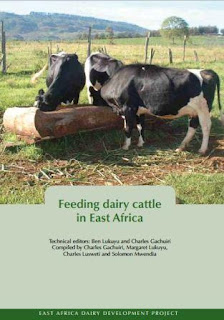
Feeding dairy cattle: Regional experts develop manual for farmers in East Africa


The East Africa Dairy Development project has produced a manual aimed at helping farmers in the region boost the productivity of their dairy cows through adoption of improved animal feeding practices.

The manual was developed by a team of animal science experts from the International Livestock Research Institute (ILRI), the Kenya Agricultural Research Institute (KARI) and the University of Nairobi.

The topics include the basic nutrient requirements of dairy cows; pasture management; production of forage such as hay and silage; feed supplements; practical aspects of feeding calves, heifers and dairy cows; and how to control forage diseases like Napier grass head smut.

Whereas the information has been synthesized in such a way as to be applicable to the East African region, some information may be site specific, and in some instances information that is generalized may need to be customized to suit specific areas.

The manual builds on an earlier version produced by the Smallholder Dairy Project and the Kenya Dairy Development Program that was designed to guide extension workers and smallholder dairy farmers through the basics of feeding dairy animals.

Although dairy farmers are the primary audience of the manual, it may also be a useful information resource for extension workers as well as students of animal production.

For more information, please contact ILRI feed scientist Ben Lukuyu (b.lukuyu @ cgiar.org)
Download the manual

Citation
Lukuyu B, Gachuiri CK, Lukuyu MN, Lusweti C and Mwendia S (eds). 2012. Feeding dairy cattle in East Africa. East Africa Dairy Development Project, Nairobi, Kenya.

You may also be interested in:
Study identifies feed improvement options for dairy farmers in East Africa

Friday, April 20, 2012

PhD students and interns gain from ILRI training workshop on research methods


Kristina Roesel presents her PhD proposal during a training workshop on research methods
Kristina Roesel presents her PhD proposal during a training workshop on research methods held at ILRI Nairobi (photo credit: ILRI/Tezira Lore).

On 17-18 April 2012, the Nairobi-based International Livestock Research Institute (ILRI) held a training workshop on research methods for eight PhD students and interns attached to ILRI's Animal Health, Food Safety and Zoonoses team which is led by Delia Grace.

The training was facilitated by staff from ILRI's Research Methods Group, InfoCentre, and Markets, Gender and Livelihoods research theme.

The topics included an introduction to R software for data analysis; systematic literature review; using Mendeley to manage and share research papers; presentation skills; integrating gender analysis in research design; animal care and use; research ethics; how to search for journal articles; and use of web 2.0 tools to communicate research.

The session on gender analysis in research design facilitated by Elizabeth Waithanji of ILRI's Poverty, Gender and Impact team was particularly useful in helping the students to define gender-responsive goals and objectives leading to the development of research hypotheses and data collection tools that incorporate gender.

"Disaggregating data collection by gender will enable the generation of research evidence on how men and women are impacted differently by the interventions," Waithanji said.

James Kahunyo presents his PhD proposal during a training workshop on research methods
James Kahunyo presents his PhD proposal during a training workshop on research methods held at ILRI Nairobi. Delia Grace (standing left) facilitates the discussion  (photo credit: ILRI/Tezira Lore). 

The students also presented their PhD proposals to each other and benefited from group discussions on how to fine-tune their project objectives and scope of activities.

Delia Grace, who is also the coordinator of the agriculture-associated diseases component of the CGIAR Research Program on Agriculture for Nutrition and Health, gave the students tips on how to improve their presentation skills to enable them effectively communicate their research not only to their peers but also to international and non-specialist audiences.

"I found the training to be a very useful opportunity for me to practise my presentation skills and I hope to get better with time," said Isaiah Akuku, a research intern attached to ILRI under a capacity strengthening program of the Consortium for National Health Research (CNHR).

"During my internship, I hope to gain knowledge, skills and experience in research for health so that I can contribute to tackling emerging infectious diseases," he added.

The students' research projects fall under the areas of emerging infectious diseases and zoonoses (Rift Valley fever and mapping of zoonoses hotspots) and food safety (mycotoxins, and public health risks associated with dairy and pig value chains).

The students are from Freie Universität Berlin, the University of Nairobi and Wageningen University.

Monday, April 16, 2012

Second phase of the ILRI-led Safe Food, Fair Food project gets underway


On 12–13 April 2012, the Nairobi campus of the International Livestock Research Institute (ILRI) hosted an inception meeting for the BMZ/GIZ-funded, ILRI-led Safe Food, Fair Food project to develop action plans for the second 3-year phase of the project to build on previous work from 2008-11.

Present at the inception meeting were project partners from Côte d’Ivoire (Centre Suisse de Recherches Scientifiques), Ethiopia (Addis Ababa University), Germany (Federal Institute for Risk Assessment [BfR] and Freie Universität Berlin), Ghana (University of Ghana), Japan (Rakuno Gakuen University), Kenya (University of Nairobi), Mozambique (Direcção de Ciências Animais), Tanzania (Sokoine University of Agriculture) and Uganda (Makerere University).

During the first phase of the project, a number of studies on participatory risk analysis were carried out in eastern, southern and West Africa. The project also held national workshops to engage policymakers to raise awareness about the potential food safety hazards that exist along the entire value chain.

Findings from the project also featured prominently at the first International Congress on Pathogens at the Human-Animal Interface (ICOPHAI) held in September 2011 in Addis Ababa, Ethiopia where some 25 oral and poster presentations were made by researchers and MSc and PhD students attached to the project.

Also in September 2011, the project held its final synthesis workshop to deliberate on the results of national impact assessment studies and develop a project synthesis book which will facilitate dissemination of the research findings to wider audiences.

The project now moves into its second phase which will adopt an action research approach for stakeholder engagement at the regional level towards uptake of tools and approaches to enhance food safety in informal markets in Africa.

For more information, visit the project web page or view the project publications.