News and updates on research on livestock value chains by the International Livestock Research Institute and partners

Thursday, June 30, 2011

Regional experts adopt recommendations towards safe livestock trade between the Horn of Africa and the Middle East


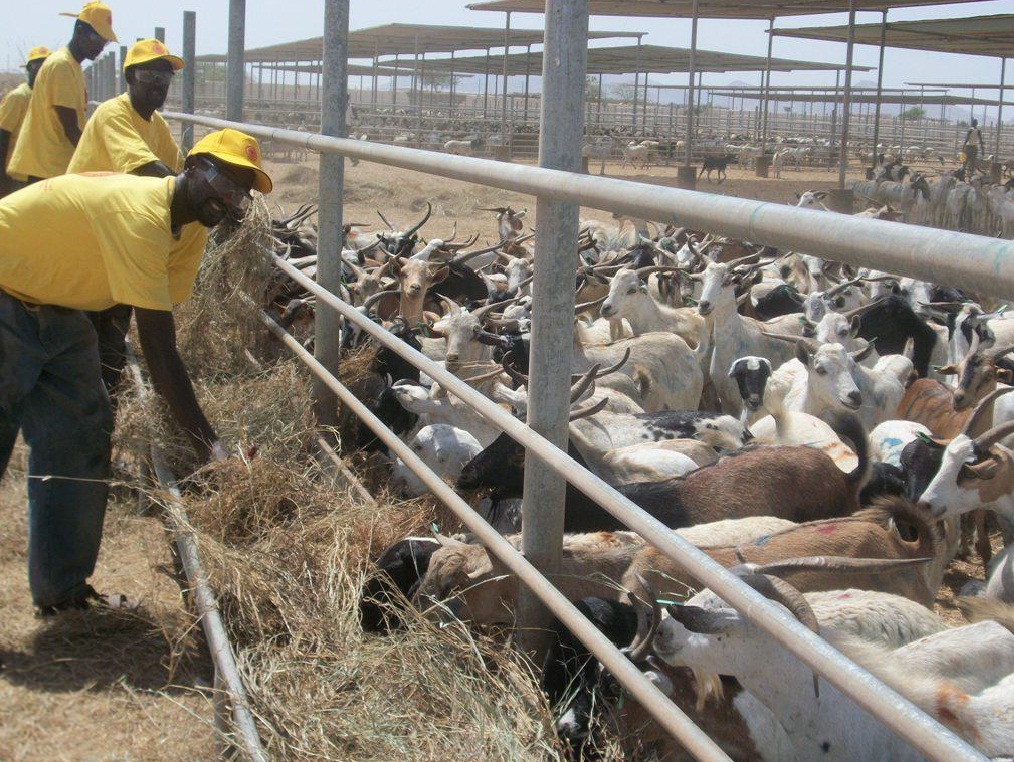
Feeding time for goats in a quarantine station: Regional livestock experts from the Horn of Africa and the Middle East have adopted recommendations towards harmonized, risk-based approaches to control of trade-related transboundary animal diseases (Photo: Saudi-Emirates International Veterinary Quarantine Management Co.)


Following a meeting in Dubai, United Arab Emirates on 13-16 June 2011, some 70 regional and international livestock experts endorsed and adopted a set of recommendations aimed at enhancing safe inter-regional livestock trade between exporting countries in the Horn of Africa and importing countries in the Middle East.

The objectives of the workshop were to:
  • Examine the use of the decision support tool for adoption in prevention and control of Rift Valley fever
  • Assemble an approach to regional harmonization for control of other transboundary animal diseases that impact on livestock trade
  • Delineate animal welfare issues along the marketing chain and propose potential interventions
  • Devise mechanisms for ensuring enhanced communication between the trading partners
  • Define the way forward on risk-based approaches to livestock certification
The workshop participants made recommendations on the following aspects that were discussed during the 4-day meeting:
  • Standard Methods and Procedures
  • Rift Valley fever decision support tool
  • Communication between livestock trading partners
  • Animal health certification
  • Animal welfare
  • Application of the principle of equivalence
The workshop was convened by a consortium of partners comprising the African Union – Interafrican Bureau for Animal Resources (AU-IBAR) as the lead implementing agency, the International Livestock Research Institute (ILRI), the World Organization for Animal Health (OIE), the United States Agency for International Development (USAID) and the United States Department of Agriculture (USDA).


For more information about the workshop activities and to access the presentations, please visit http://rvfworkshop2011.wordpress.com

To view the workshop presentations, please visit http://www.slideshare.net/marketsblog/presentations

Wednesday, June 08, 2011

Regional workshop to discuss risk-based approaches for livestock certification and control of animal diseases


Livestock sector stakeholders from the Horn of Africa and the Middle East will discuss risk-based approaches for control of transboundary animal diseases. (Photo credit: ILRI/Mann. Cattle being watered at the Ghibe River in southwestern Ethiopia.)

Chief veterinary officers and livestock sector stakeholders from several countries in the Horn of Africa and the Middle East meet in Dubai, United Arab Emirates on 13-16 June 2011 for a workshop on enhancing safe inter-regional livestock trade between exporting countries in the Horn of Africa and importing countries in the Middle East. Some 70 participants are expected to attend.

The purpose of the workshop is to:
  • Review the Rift Valley fever situation in the East Africa and Middle East sub-regions;
  • Discuss and test the use of a‘decision support tool’ for prevention and control of Rift Valley fever;
  • Consult on a regional mechanism for coordination for prevention and control of Rift Valley fever using the decision support tool; and
  • Discuss an approach to regional harmonization for control of other transboundary animal diseases that impact livestock trade.

The workshop is convened by the African Union – Interafrican Bureau for Animal Resources (AU-IBAR), the International Livestock Research Institute (ILRI), the United States Agency for International Development (USAID) and the World Organization for Animal Health (OIE).

ILRI’s Market Opportunities theme will be represented by veterinary epidemiologist Dr Bernard Bett, who will facilitate a session on communication among livestock trading partners.

ILRI is also represented by Dr Jeffrey Mariner, a veterinary epidemiologist with the Biotechnology theme who will facilitate several sessions on the Rift Valley fever decision support tool, a risk-based framework that guides responses to outbreaks of the disease.

More information and updates will be posted on the workshop blog, http://rvfworkshop2011.wordpress.com.

The provisional agenda is available here.

Friday, June 03, 2011

Study identifies feed improvement options for dairy farmers in East Africa

A dairy cow on a Kenyan smallholder farm feeds on maize stover. The East Africa Dairy Development project has identified opportunities for improving production and use of feed resources. (Photo credit: ILRI)

Good quality feeds and forages are crucial for successful livestock production. Studies have shown that in Africa and other developing countries animal feeds and feeding make up 60-70% of total production costs.

Many smallholder livestock keepers face several constraints related to feeds and feeding, including inadequate quality and quantity of feeds, inefficient supply chains and poor storage facilities, all of which have a negative impact on livestock productivity.

The East Africa Dairy Development (EADD) project is working with dairy farmers in the region to improve household incomes through integrated interventions in dairy production, market access and knowledge application. The project is currently being piloted in 8 sites in Rwanda, 18 in Kenya and 27 in Uganda.

The project carried out a rapid appraisal in four study sites in Kenya to identify practical interventions towards more efficient use of livestock feed resources and, consequently, increased productivity.

The findings of the study are published in the May 2011 edition of Livestock Research for Rural Development. The lead author, Dr Ben Lukuyu, is a feed specialist with ILRI's Market Opportunities research theme.

The EADD project is a regional industry development program implemented by a consortium of partners led by Heifer International. The other project partners are the African Breeders Services Total Cattle Management (ABS-TCM), the International Livestock Research Institute (ILRI), TechnoServe and the World Agroforestry Centre (ICRAF).

The rapid appraisal assessed the livestock feeding practices in smallholder dairy systems; identified where gaps in feed supply occur for feed resources that are not available year-round; and determined some practices that dairy farmers can adopt to ensure a reliable supply of high-quality livestock feed all year round.

The study identified various options to improve the use and storage of on-farm feed resources such as processing of feed by chopping or chaffing which have been shown to increase milk production per kilogram of feed consumed, as well as feed conservation by silage-making and baling of hay to help cope with the dry season shortage and ensure an adequate supply of feed.

However, for sustainable uptake of these interventions, the authors note that there will be need to improve farmer training and access to information, and to strengthen linkages with stakeholders.

Read the full-text article here

Citation
Lukuyu B, Franzel S, Ongadi PM and Duncan AJ. 2011. Livestock feed resources: Current production and management practices in central and northern rift valley provinces of Kenya. Livestock Research for Rural Development Volume 23, Article #112. Retrieved June 3, 2011, from http://www.lrrd.org/lrrd23/5/luku23112.htm

Friday, May 27, 2011

Collaborative approaches towards better livestock data quality in Africa


Although there are currently several types of livestock data and indicators in Africa, many are difficult to access, such as productivity indicators, livestock inventories and marketing-related data.

On the other hand, some livestock-related data may be readily accessible but with attendant quality issues thereby potentially undermining their reliability and usefulness in policymaking and development planning.

The Livestock Data Innovation project seeks to address these issues through collaborative approaches aimed at improving the quality and accessibility of livestock data and promoting pro-poor investments in the livestock sector in sub-Saharan Africa.

This is a 3-year project sponsored by the Bill and Melinda Gates Foundation and implemented by the World Bank, the International Livestock Research Institute (ILRI) and the Food and Agriculture Organization of the United Nations (FAO) in collaboration with the African Union - Interafrican Bureau for Animal Resources (AU-IBAR).

The presentation below, Livestock data in sub-Saharan Africa: Availability and issues, by Derek Baker of ILRI, Ibrahim Ahmed of AU-IBAR and Ugo Pica-Ciamarra of FAO highlights some of the quality and accessibility issues associated with livestock data in Africa and some proposed approaches of the project and of the AU-IBAR-led Animal Resources Information System 2 (ARIS 2) towards addressing these issues.


For more information, please visit the project web page.

Tuesday, May 24, 2011

Study reviews 20 years of global livestock disease dynamics


Livestock-dependent smallholder and pastoralist systems in developing countries have been identified as one of three trajectories of global disease dynamics. (Photo credit: ILRI/Mann)

From a livestock and global change special feature in the Proceedings of the National Academy of Sciences of the United States of America (online 16 May 2011) comes a review paper on global livestock disease dynamics by Brian Perry, Delia Grace and Keith Sones.

Dr Delia Grace, a veterinary epidemiologist and food safety expert, leads the International Livestock Research Institute (ILRI) research team on animal health and food safety for trade.

Lead author, Prof Brian Perry, is an Honorary Research Fellow in the Nuffield Department of Medicine, University of Oxford, UK (based in Kenya), and Extraordinary Professor at the Faculty of Veterinary Science, University of Pretoria, South Africa. A veterinary surgeon by profession, he previously worked at ILRI for 20 years and led the research team on animal health and food safety for trade.

Dr Keith Sones is an animal health specialist with the Nairobi-based Keith Sones Associates.

The paper reviews the changing patterns of livestock disease over the last 20 years, discusses the main drivers of these patterns and plots future trajectories of livestock disease risk and associated control.

While acknowledging the complexity of disease dynamics, the authors point to three main drivers of changing livestock disease dynamics: ecosystem change, ecosystem incursion, and movement of people and animals. Underlying these dynamics are the growing demand for livestock products (the Livestock Revolution) and increasing human population size.

Three trajectories of global disease dynamics are identified as: (1) the intensified and worried well of the Western world, (2) intensifying and market-orientated sectors of the developing world (hot spots) and (3) smallholder systems dependent on traditional livestock-derived livelihoods (cold spots).

Read the abstract

Citation
Perry BD, Grace D and Sones K. 2011. Current drivers and future directions of global livestock disease dynamics. Proceedings of the National Academy of Sciences of the United States of America, 16 May 2011. doi 10.1073/pnas.1012953108

Thursday, May 12, 2011

ILRI film features integrated community-based methods to control trypanosomosis in West Africa


Livestock keepers in West Africa rely largely on treating their cattle with drugs to protect them from trypanosomosis, but resistance to these drugs has emerged in many areas.

This training film (approx. 13 minutes) from the project, Preventing and containing trypanocide resistance in the cotton zone of West Africa, outlines good practices for improving the use of drugs and slowing the emergence of resistance.

These practices, which are based on Rational Drug Use, an approach from human health now adapted for animal care, are clearly explained so that veterinary workers and farmers can treat animals safely.

Rational Drug Use can be combined with other methods that reduce the numbers of tsetse flies to further slow the spread of resistance to trypanocidal medicines.

This is one of three films telling the story of the current state of the war against a disease that is so deadly and widespread that farmers call it 'the malaria of cattle'.

Also see this related post on Livestock Markets DigestStudy calls for participatory approach to prevent trypanocide drug resistance in West Africa

Wednesday, May 11, 2011

Study explores economic impacts of livestock commodity-based trade with health & safety focus

Commodity-based trade that focuses on health and safety attributes of the product rather than the status of the country of origin is one option for increasing market access for livestock products from Africa, a new study recommends.

Livestock market opportunities in Africa have traditionally been limited by the presence of certain infectious diseases that pose risks to animal and human health.

The study, published in the April 2011 online edition of Development Policy Review, analyses the technical considerations and likely economic effects of this innovative approach to commodity-based trade.

The paper was written by Dr Karl Rich of the Norwegian Institute of International Affairs (NUPI) and the International Livestock Research Institute (ILRI), and Prof Brian Perry of University of Oxford, University of Edinburgh, and University of Pretoria.

View the abstract here

Citation
Rich KM and Perry BD. 2011. Whither commodity-based trade? Development Policy Review 29(3): 331-357.