News and updates on research on livestock value chains by the International Livestock Research Institute and partners

Thursday, July 28, 2011

New book features case studies on Kenya’s liberalized dairy sector

Improved functioning of Kenya’s dairy marketing systems in the period following the liberalization of the sector in 1992 is a critical factor affecting the improvement of dairy production systems, two new studies report.

The studies feature in a newly published book by Springer (April 2011) titled Emerging Development of Agriculture in East Africa.

Agricultural economists from the Market Opportunities Theme of the International Livestock Research Institute (ILRI), Dr Isabelle Baltenweck and Dr Steve Staal, are chapter co-authors.

Dr Staal is the director of ILRI’s Market Opportunities theme which carries out research aimed at providing appropriate technical, policy and institutional options that will enable the poor, especially women and other marginalized groups, to participate more effectively in remunerative livestock markets.

The chapter, Emerging markets in the post-liberalization period: Evidence from the raw milk market in rural Kenya by Kijima, Yamano and Baltenweck examines the development of raw milk markets in western and central Kenya while the chapter, Dynamic changes in the uptake of dairy technologies in the Kenya Highlands by Baltenweck, Yamano and Staal investigates the dynamics of dairy production in the post-liberalization period.


Citations
Baltenweck I, Yamano T and Staal SJ. 2011. Dynamic changes in the uptake of dairy technologies in the Kenya Highlands.  In: Yamano T, Otsuka K and Place F (eds), Emerging development of agriculture in East Africa. Springer, Netherlands. pp. 85-97.

Kijima Y, Yamano T and Baltenweck I. 2011. Emerging markets in the post-liberalization period: Evidence from the raw milk market in Kenya. In: Yamano T, Otsuka K and Place F (eds), Emerging development of agriculture in East Africa. Springer, Netherlands. pp. 73-84.

Wednesday, July 27, 2011

Ecohealth approaches can improve food safety management in Vietnam

Pork seller at a market in Vietnam: One Health and Ecohealth approaches can improve the management of food safety and zoonotic diseases in Vietnam. (Photo credit: ILRI).

Food safety is a major concern for the government of Vietnam. According to the World Health Organization Representative Office in Vietnam, the human costs of food-borne diseases, lost production from diseases and related market losses surpass USD 1 billion per year, an amount equivalent to 2% of Vietnam's Gross Domestic Product.

The topic of food safety management in Vietnam featured at the Second Food Safety and Zoonoses Symposium for Asia Pacific that was held in Chiang Mai, Thailand on 21-22 July 2011.

A presentation by Dr Hung Nguyen-Viet of the Hanoi School of Public Health, Vietnam and researchers from the International Livestock Research Institute (ILRI) considered the challenges, costs and benefits of One Health and Ecohealth approaches to food safety in Vietnam.

Ecohealth and One Health approaches assume that human, livestock, wildlife and environmental health are integrally related.

The presentation also highlighted a number of food safety research projects by ILRI in Vietnam, including the project on ecosystem approaches to the better management of zoonotic emerging infectious diseases in Southeast Asia which is coordinated Dr Jeffrey Gilbert, a veterinary epidemiologist with ILRI’s research team on animal health, food safety and zoonoses.


Citation
Nguyen-Viet H, Grace D, Lapar ML, Unger F, McDermott J and Gilbert J. 2011. Linking research and management of food safety within One Health/Ecohealth context in Vietnam: Concepts and applications. Presentation at the 2nd Food Safety and Zoonoses Symposium for Asia Pacific, Chiang Mai, Thailand, 21-22 July 2011.

Friday, July 15, 2011

Participatory risk analysis: A promising approach to improving food safety in sub-Saharan Africa

Pork and beef sellers in Xipamanine Market, Maputo, Mozambique. Participatory risk analysis offers a new approach to managing the safety of informally produced and marketed food in sub-Saharan Africa. (Photo credit: ILRI/Mann)

Most food in sub-Saharan Africa is produced and sold in the informal sector which is an important source of income, employment and livelihood for millions of poor food producers and sellers.

However, several studies have shown that informally marketed food contains high levels of microbial hazards that pose a threat to public health.

In order to appropriately tackle this problem, approaches are needed that focus on the risk to human health and how best this risk can be assessed and managed rather than focusing solely on the presence of hazards.

For example, the common practice of boiling of milk before drinking it kills disease-causing microorganisms, thereby significantly reducing the public health risks posed by the presence of milk-borne pathogens.

Risk analysis, therefore, presents a new approach to managing food safety and the use of participatory methodologies can improve stakeholder engagement and compliance.

Although risk analysis is now widely applied in much of the developed world and forms the basis of food safety guidelines for domestic and international trade, its use in developing countries has been limited.

This is largely because risk-based approaches to food safety have not been appropriately adapted to suit the prevailing situation in developing countries where informal markets dominate and exist alongside formal markets, and capacity to enforce compliance is low.

The collaborative Safe Food, Fair Food project is currently working to improve the management of the safety of livestock food products by adapting risk-based approaches to suit domestic informal livestock markets in developing countries in sub-Saharan Africa.

The project is led by the Market Opportunities theme of the International Livestock Research Institute (ILRI) and funded by the Federal Ministry for Economic Cooperation and Development (BMZ).

The project involves several partners from eight countries in east, west and south Africa, namely, Côte d’Ivoire, Ethiopia, Ghana, Kenya, Mali, Mozambique, the Republic of South Africa and Tanzania and covers 19 participatory risk analysis topics.

Preliminary results from the proof of concept studies support the hypothesis that risk-based approaches may be useful in improving food safety in informal markets in developing countries.

The application of participatory risk analysis towards improved food safety in sub-Saharan Africa is discussed in a review paper published in the journal, Revue Africaine de Santé et de Productions Animales. The lead author of the paper, Dr Delia Grace, heads ILRI's research team on animal health, food safety and zoonoses.

Click here to read the abstract and access the review paper

For more information, visit the Safe Food, Fair Food project web page


Citation
Grace D, Makita K, Kang'ethe EK and Bonfoh B. 2010. Safe food, fair food: Participatory risk analysis for improving the safety of informally produced and marketed food in sub-Saharan Africa. Revue Africaine de Santé et de Productions Animales 8(S): 3-11.

Monday, July 11, 2011

East Africa dairy experts seek harmonized standards to promote regional trade


Dairy experts in East Africa are working towards harmonization of dairy policies and standards in a bid to promote regional trade in milk and dairy products and enhance access to markets.

In line with this objective, representatives from the East African Community (EAC) Secretariat and the East Africa Dairy Regulatory Authorities Council (EADRAC) met in Arusha, Tanzania on 6-7 July 2011 to review progress made in harmonization of regional dairy policies and standards.

EADRAC is a forum that comprises chairpersons, chief executives and key technical staff of national dairy boards and regulatory authorities from five EAC member countries, namely, Burundi, Kenya, Rwanda, Tanzania and Uganda.

EADRAC was formed in 2006 to work towards harmonization of dairy policies and standards in the region as well as foster the sharing of lessons among countries.

The Association for Strengthening Agricultural Research in Eastern and Central Africa (ASARECA) and the International Livestock Research Institute (ILRI) have been working in partnership with EADRAC to provide the research evidence needed to inform and guide the policy actions by the dairy regulatory authorities.

The two-day meeting was organized by ASARECA, ILRI and the EAC Secretariat.

The participants discussed trends in intra-regional trade in dairy products, reduction of tariff and non-tariff barriers across regional borders, and the implications of the recently revised Codex Alimentarius clause on the use of the lactoperoxidase system (LPS) in preservation of raw milk.

ILRI was represented at the meeting by two scientists from the Market Opportunities theme, veterinary epidemiologist, Dr Amos Omore and agricultural economist, Dr Ayele Gelan.

ILRI shared evidence from recent commissioned research work on the impacts of changing tariff and non-tariff barriers on regional dairy trade, and on the use of LPS in milk preservation, which the forum thought needed wider consultations including a revision of the relevant regional dairy standards before piloting of the system.

EADRAC meetings are held about annually, with the last one held in early December 2009 at ILRI's Nairobi headquarters, back-to-back with a South-South Dairy Symposium involving dairy researchers and policymakers from East Africa and Northeast India.

India is currently the world's largest milk producer and, as in East Africa, the traditional dairy sector dominates the marketing of milk.

The forum proposed a conference in June 2012 in Kampala, Uganda to bring together a wider group of regional stakeholders including, EADRAC, ASARECA, ILRI and the East Africa Agricultural Productivity Programme to review progress made and new actions required towards further harmonization of dairy policies in the region.

"EADRAC is positioning itself to be the main technical agency for addressing non-tariff barriers to trade in East Africa once it is recognized as such by the EAC Secretariat, and memorandum of understanding detailing this relationship is under consideration" said Dr Omore.

Related links 
EAC official seeks transformation of regional dairy sector (Daily Nation, 7 July 2011)

Symposium develops policy to transform traditional dairy markets in East Africa and Northeast India (Livestock Markets Digest, 15 December 2009)

CEOs of East African dairy boards endorse harmonized milk training curricula for informal traders (Livestock Markets Digest, 17 February 2006)

Thursday, June 30, 2011

Persistence of high food prices in Eastern Africa: What role for policy?

High food prices in Eastern Africa and the role of policy: Dr Joseph Karugia presents at an Open Forum on Agricultural Biotechnology lunch seminar
The coordinator of the Regional Strategic Analysis and Knowledge Support System for Eastern and Central Africa (ReSAKSS-ECA), Dr Joseph Karugia, today afternoon (30 June 2011) gave a presentation titled “Persistence of high food prices in Eastern Africa: What role for policy?” at a lunch seminar at the Jacaranda Hotel, Nairobi. The seminar was organized by the Kenya Chapter of the Open Forum on Agricultural Biotechnology in Africa (OFAB).

Dr Karugia presented some regional perspectives to the food price situation in Eastern and Southern Africa and put forward some policy options that would best enable governments and other stakeholders to respond in a timely manner, based on evidence from research data.

Sharing research with the general public: Dr Joseph Karugia does a piece-to-camera  for the Kenya News Agency (KNA) after his OFAB seminar on high food prices in Eastern Africa and the role of policy
Earlier this week, Dr Karugia was also interviewed on the same subject on two live television shows -- The Breakfast Show by NTV and The Platform by Kenya Broadcasting Corporation (KBC).

Curbing rising food prices: Screen grab of Dr Joseph Karugia (right) in a live Kenya Broadcasting Corporation television interview on 28 June 2011 by journalist Kasujaa Onyonyi (left)
 
ReSAKSS-ECA is based at the Nairobi headquarters of the International Livestock Research Institute (ILRI) in Nairobi under the Market Opportunities research theme.

ReSAKSS is an Africa-wide network established to provide readily available analysis, data, and tools of the highest quality to promote evidence-based decision-making on policy issues on Agriculture in Africa.

To find out more about ReSAKSS, please visit http://www.resakss.org

Regional experts adopt recommendations towards safe livestock trade between the Horn of Africa and the Middle East


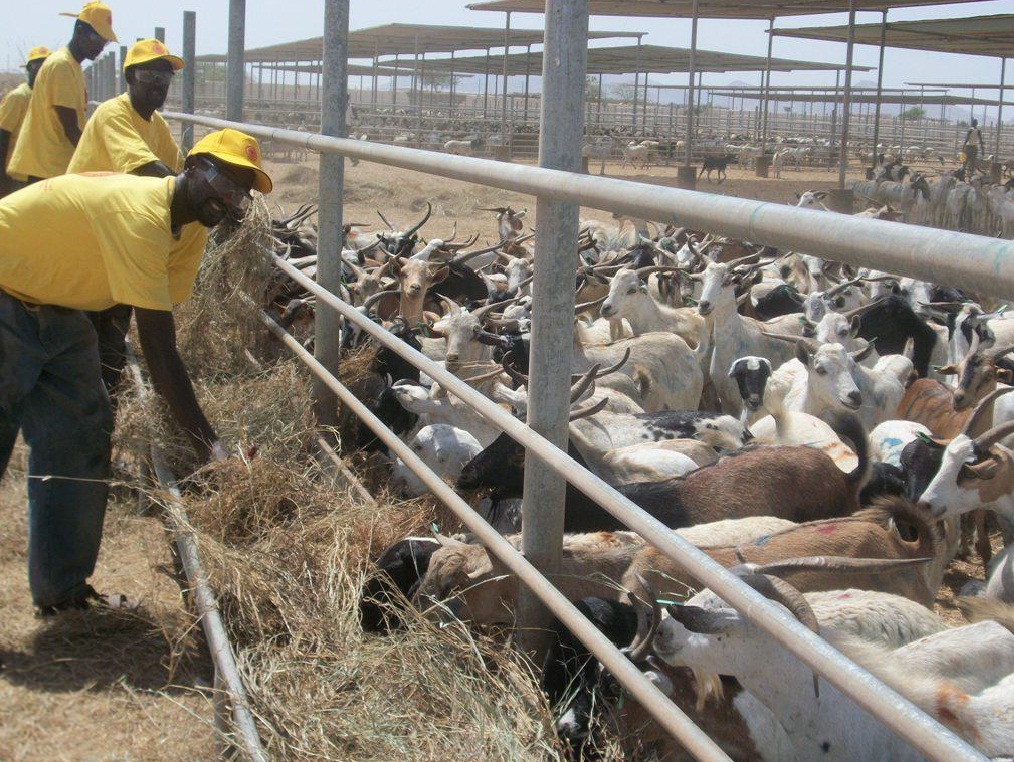
Feeding time for goats in a quarantine station: Regional livestock experts from the Horn of Africa and the Middle East have adopted recommendations towards harmonized, risk-based approaches to control of trade-related transboundary animal diseases (Photo: Saudi-Emirates International Veterinary Quarantine Management Co.)


Following a meeting in Dubai, United Arab Emirates on 13-16 June 2011, some 70 regional and international livestock experts endorsed and adopted a set of recommendations aimed at enhancing safe inter-regional livestock trade between exporting countries in the Horn of Africa and importing countries in the Middle East.

The objectives of the workshop were to:
  • Examine the use of the decision support tool for adoption in prevention and control of Rift Valley fever
  • Assemble an approach to regional harmonization for control of other transboundary animal diseases that impact on livestock trade
  • Delineate animal welfare issues along the marketing chain and propose potential interventions
  • Devise mechanisms for ensuring enhanced communication between the trading partners
  • Define the way forward on risk-based approaches to livestock certification
The workshop participants made recommendations on the following aspects that were discussed during the 4-day meeting:
  • Standard Methods and Procedures
  • Rift Valley fever decision support tool
  • Communication between livestock trading partners
  • Animal health certification
  • Animal welfare
  • Application of the principle of equivalence
The workshop was convened by a consortium of partners comprising the African Union – Interafrican Bureau for Animal Resources (AU-IBAR) as the lead implementing agency, the International Livestock Research Institute (ILRI), the World Organization for Animal Health (OIE), the United States Agency for International Development (USAID) and the United States Department of Agriculture (USDA).


For more information about the workshop activities and to access the presentations, please visit http://rvfworkshop2011.wordpress.com

To view the workshop presentations, please visit http://www.slideshare.net/marketsblog/presentations

Wednesday, June 08, 2011

Regional workshop to discuss risk-based approaches for livestock certification and control of animal diseases


Livestock sector stakeholders from the Horn of Africa and the Middle East will discuss risk-based approaches for control of transboundary animal diseases. (Photo credit: ILRI/Mann. Cattle being watered at the Ghibe River in southwestern Ethiopia.)

Chief veterinary officers and livestock sector stakeholders from several countries in the Horn of Africa and the Middle East meet in Dubai, United Arab Emirates on 13-16 June 2011 for a workshop on enhancing safe inter-regional livestock trade between exporting countries in the Horn of Africa and importing countries in the Middle East. Some 70 participants are expected to attend.

The purpose of the workshop is to:
  • Review the Rift Valley fever situation in the East Africa and Middle East sub-regions;
  • Discuss and test the use of a‘decision support tool’ for prevention and control of Rift Valley fever;
  • Consult on a regional mechanism for coordination for prevention and control of Rift Valley fever using the decision support tool; and
  • Discuss an approach to regional harmonization for control of other transboundary animal diseases that impact livestock trade.

The workshop is convened by the African Union – Interafrican Bureau for Animal Resources (AU-IBAR), the International Livestock Research Institute (ILRI), the United States Agency for International Development (USAID) and the World Organization for Animal Health (OIE).

ILRI’s Market Opportunities theme will be represented by veterinary epidemiologist Dr Bernard Bett, who will facilitate a session on communication among livestock trading partners.

ILRI is also represented by Dr Jeffrey Mariner, a veterinary epidemiologist with the Biotechnology theme who will facilitate several sessions on the Rift Valley fever decision support tool, a risk-based framework that guides responses to outbreaks of the disease.

More information and updates will be posted on the workshop blog, http://rvfworkshop2011.wordpress.com.

The provisional agenda is available here.