News and updates on research on livestock value chains by the International Livestock Research Institute and partners

Wednesday, April 25, 2012

Feeding dairy cattle: Regional experts develop manual for farmers in East Africa


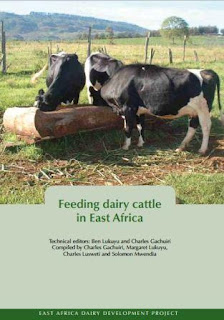
The East Africa Dairy Development project has produced a manual aimed at helping farmers in the region boost the productivity of their dairy cows through adoption of improved animal feeding practices.

The manual was developed by a team of animal science experts from the International Livestock Research Institute (ILRI), the Kenya Agricultural Research Institute (KARI) and the University of Nairobi.

The topics include the basic nutrient requirements of dairy cows; pasture management; production of forage such as hay and silage; feed supplements; practical aspects of feeding calves, heifers and dairy cows; and how to control forage diseases like Napier grass head smut.

Whereas the information has been synthesized in such a way as to be applicable to the East African region, some information may be site specific, and in some instances information that is generalized may need to be customized to suit specific areas.

The manual builds on an earlier version produced by the Smallholder Dairy Project and the Kenya Dairy Development Program that was designed to guide extension workers and smallholder dairy farmers through the basics of feeding dairy animals.

Although dairy farmers are the primary audience of the manual, it may also be a useful information resource for extension workers as well as students of animal production.

For more information, please contact ILRI feed scientist Ben Lukuyu (b.lukuyu @ cgiar.org)
Download the manual

Citation
Lukuyu B, Gachuiri CK, Lukuyu MN, Lusweti C and Mwendia S (eds). 2012. Feeding dairy cattle in East Africa. East Africa Dairy Development Project, Nairobi, Kenya.

You may also be interested in:
Study identifies feed improvement options for dairy farmers in East Africa

Friday, April 20, 2012

PhD students and interns gain from ILRI training workshop on research methods


Kristina Roesel presents her PhD proposal during a training workshop on research methods
Kristina Roesel presents her PhD proposal during a training workshop on research methods held at ILRI Nairobi (photo credit: ILRI/Tezira Lore).

On 17-18 April 2012, the Nairobi-based International Livestock Research Institute (ILRI) held a training workshop on research methods for eight PhD students and interns attached to ILRI's Animal Health, Food Safety and Zoonoses team which is led by Delia Grace.

The training was facilitated by staff from ILRI's Research Methods Group, InfoCentre, and Markets, Gender and Livelihoods research theme.

The topics included an introduction to R software for data analysis; systematic literature review; using Mendeley to manage and share research papers; presentation skills; integrating gender analysis in research design; animal care and use; research ethics; how to search for journal articles; and use of web 2.0 tools to communicate research.

The session on gender analysis in research design facilitated by Elizabeth Waithanji of ILRI's Poverty, Gender and Impact team was particularly useful in helping the students to define gender-responsive goals and objectives leading to the development of research hypotheses and data collection tools that incorporate gender.

"Disaggregating data collection by gender will enable the generation of research evidence on how men and women are impacted differently by the interventions," Waithanji said.

James Kahunyo presents his PhD proposal during a training workshop on research methods
James Kahunyo presents his PhD proposal during a training workshop on research methods held at ILRI Nairobi. Delia Grace (standing left) facilitates the discussion  (photo credit: ILRI/Tezira Lore). 

The students also presented their PhD proposals to each other and benefited from group discussions on how to fine-tune their project objectives and scope of activities.

Delia Grace, who is also the coordinator of the agriculture-associated diseases component of the CGIAR Research Program on Agriculture for Nutrition and Health, gave the students tips on how to improve their presentation skills to enable them effectively communicate their research not only to their peers but also to international and non-specialist audiences.

"I found the training to be a very useful opportunity for me to practise my presentation skills and I hope to get better with time," said Isaiah Akuku, a research intern attached to ILRI under a capacity strengthening program of the Consortium for National Health Research (CNHR).

"During my internship, I hope to gain knowledge, skills and experience in research for health so that I can contribute to tackling emerging infectious diseases," he added.

The students' research projects fall under the areas of emerging infectious diseases and zoonoses (Rift Valley fever and mapping of zoonoses hotspots) and food safety (mycotoxins, and public health risks associated with dairy and pig value chains).

The students are from Freie Universität Berlin, the University of Nairobi and Wageningen University.

Monday, April 16, 2012

Second phase of the ILRI-led Safe Food, Fair Food project gets underway


On 12–13 April 2012, the Nairobi campus of the International Livestock Research Institute (ILRI) hosted an inception meeting for the BMZ/GIZ-funded, ILRI-led Safe Food, Fair Food project to develop action plans for the second 3-year phase of the project to build on previous work from 2008-11.

Present at the inception meeting were project partners from Côte d’Ivoire (Centre Suisse de Recherches Scientifiques), Ethiopia (Addis Ababa University), Germany (Federal Institute for Risk Assessment [BfR] and Freie Universität Berlin), Ghana (University of Ghana), Japan (Rakuno Gakuen University), Kenya (University of Nairobi), Mozambique (Direcção de Ciências Animais), Tanzania (Sokoine University of Agriculture) and Uganda (Makerere University).

During the first phase of the project, a number of studies on participatory risk analysis were carried out in eastern, southern and West Africa. The project also held national workshops to engage policymakers to raise awareness about the potential food safety hazards that exist along the entire value chain.

Findings from the project also featured prominently at the first International Congress on Pathogens at the Human-Animal Interface (ICOPHAI) held in September 2011 in Addis Ababa, Ethiopia where some 25 oral and poster presentations were made by researchers and MSc and PhD students attached to the project.

Also in September 2011, the project held its final synthesis workshop to deliberate on the results of national impact assessment studies and develop a project synthesis book which will facilitate dissemination of the research findings to wider audiences.

The project now moves into its second phase which will adopt an action research approach for stakeholder engagement at the regional level towards uptake of tools and approaches to enhance food safety in informal markets in Africa.

For more information, visit the project web page or view the project publications.

Wednesday, March 28, 2012

Linking smallholder women farmers to markets: Which approaches work best?

The first-ever global conference on women in agriculture was held on 13-15 March 2012 in New Delhi, India. The conference gathered women farmers, researchers, policymakers and other stakeholders from all over the world to discuss current and emerging gender-related issues in agriculture and research, as well as derive lessons for future sustainable, gender-sensitive development.

The International Livestock Research Institute (ILRI) was represented at the conference by Jemimah Njuki, leader of ILRI's Poverty, Gender and Impact team.

Njuki's presentation, Linking women farmers to markets: Patterns of market participation, decision making and intra-household income management, explored various approaches to linking smallholder women to markets as a critical pathway towards their economic empowerment.

View the presentation below.

Wednesday, March 21, 2012

Informal channels are key sources of livestock information for Kenya’s rural farmers

Maasai father and son tend to their cattle in Kenya
Maasai father and son tend to their cattle in Kenya. Informal channels are important sources of livestock information but there are gender disparities in access to information among male-headed rural households in Kenya (photo credit: ILRI/Mann).

Informal channels such as farmer to farmer interactions are more important sources of information on livestock production and marketing for rural farmers in Kenya than co-operative groups, government extension services and radio, a new study has found.

However, this farmer to farmer exchange is more popular among women farmers than among their male counterparts.

The study, published in the February 2012 edition of Livestock Research for Rural Development, assessed how women’s access to livestock information and financial services compares to that of men among male-headed rural households in four districts in Kenya: Kajiado, Kiambu, Meru and Tharaka.

The study also revealed gender disparities with respect to training of farmers in livestock production and marketing.

Men in male-headed households received more training on a greater variety of technical topics such as livestock breeding, health and marketing, whereas women mostly received training on general aspects of livestock management.

Trainings were mostly held within the village but outside the home.

“Increasing access to training by women will require holding training in venues that do not constrain women,” the authors suggest.

Gendered disparities were also observed in access to financial services.

Although both men and women relied on groups as their main source of credit, more men than women obtained credit from formal financial service providers such as banks, microfinance institutions and co-operative societies.

On the other hand, more women than men obtained credit from neighbours and friends.

For this reason, the authors recommend that “provision of credit facilities should be flexible and have consideration for women’s constrained access to collateral”.

Access the article

Citation
Mburu S, Njuki J and Kariuki J. 2012. Intra-household access to livestock information and financial services in Kenya. Livestock Research for Rural Development. Volume 24, Article #38. http://www.lrrd.org/lrrd24/2/mbur24038.htm

Thursday, March 01, 2012

AGRA and ILRI publish proceedings of international conference on priority actions for market development for African farmers

Mozambique
A Mozambican farmer takes her maize harvest to market. Development of agricultural markets in sub-Saharan Africa can boost economic growth and improve livelihoods (photo credit: ILRI/Mann). 

The Alliance for a Green Revolution in Africa (AGRA) and the International Livestock Research Institute (ILRI) have released the proceedings of an international conference held in Nairobi, Kenya in May 2009 to examine the role of agricultural markets in spurring economic growth in sub-Saharan Africa and improving livelihoods.

The AGRA-ILRI conference brought together 150 of the world’s leading market experts to document the practices, policies and investments that can drive agricultural market development in sub-Saharan Africa; reveal the gaps and shortcomings that continue to create barriers; and identify priority actions that should be taken by governments, the private sector, donors and other stakeholders.

The issues discussed at the conference are especially timely in light of recent surges in food prices and the significant burden this is inflicting on millions of poor people, underscoring the urgent need for action.

The proceedings include two papers lead-authored by researchers from ILRI's Markets, Gender and Livelihoods theme.

The paper, Integrating informal actors into the formal dairy industry in Kenya through training and certification by Amos Omore and Derek Baker reviews current thinking on the role of informal agribusiness in pro-poor development, and reports on the example the Smallholder Dairy Project in Kenya.

The project featured collaborative and participatory research, along with training and certification in hygienic milk handling practices as a practical mechanism for optimizing milk quality and addressing regulatory barriers.

It also targeted and helped achieve policy change, which enabled wider piloting of the training and certification activities incorporating a business development service approach by national authorities.

In their paper, The impact of non-tariff barriers on maize and beef trade in East Africa author Joseph Karugia and others report on the use a spatial equilibrium model to quantify the impact of non-tariff barriers – such as licences, taxes and customs duties – on the intra-country flow of trade in maize and beef in Kenya, Tanzania and Uganda.

The study found that reducing or completely removing the existing non-tariff barriers would result in increased intra-regional trade flows, with Kenya importing more maize from both Uganda and Tanzania, while Uganda’s beef exports to Kenya and Tanzania would increase. The overall result would be positive net welfare gains for the maize and beef sub-sectors across the entire East African Community.

Download the full book or individual sections
  • Synthesis of outcomes
  • Section 1: Developing pro-poor markets for African smallholder farmers
  • Section 2: Seed and fertilizer markets
  • Section 3: Strengthening finance, insurance and market information
  • Section 4: High-value commodities and agroprocessing
  • Section 5: Building market institutions
  • Section 6: Encouraging regional trade
For more information
Contact Anne Mbaabu of AGRA (AMbaabu @ agra-alliance.org) or Steve Staal of ILRI (s.staal @ cgiar.org) or visit the conference website.

Citation
ILRI (International Livestock Research Institute). 2011. Towards priority actions for market development for African farmers: Proceedings of an international conference. 13-15 May 2009, Nairobi, Kenya. AGRA (Alliance for a Green Revolution in Africa) and ILRI (International Livestock Research Institute), Nairobi, Kenya.

Wednesday, February 29, 2012

Global conference to discuss empowering women for inclusive growth in agriculture

Working in the maize field in Malawi

What are women’s specific needs for empowerment in agriculture? What initiatives are in place to effectively link women to markets? What are the policy, institutional, infrastructural and financial constraints affecting agricultural diversity to enhance income?  What solutions exist to reduce women’s drudgery relating to agricultural operations and household needs?

These are just a few of the questions that will be up for discussion at the first-ever global conference on women in agriculture to be held on 13-15 March 2012 at the National Agricultural Science Centre (NASC) Complex, New Delhi, India.

Under the theme, Empowering women for inclusive growth in agriculture, the conference brings together women farmers, researchers, policymakers and other stakeholders from all over the world to discuss current and emerging gender-related issues in agriculture and research, as well as derive lessons for future sustainable, gender-sensitive development.

Discussions will take place under the following themes:
  • assessing women’s  empowerment in agriculture;
  • agricultural innovations for reducing drudgery;
  • linking women to markets;
  • the role of women in household food and nutritional security;
  • policies and services to increase women’s access to assets, resources and knowledge;
  • the impact of and responses to climate-change related risks and uncertainties; and
  • strengthening capacity building and partnerships.
The conference will also develop a framework for action to integrate and empower women for inclusive growth and development through an enduring global partnership program on gender in agriculture.

At the conference, the International Livestock Research Institute (ILRI) will be represented by Jemimah Njuki, leader of the Poverty, Gender and Impact team. She is one of the speakers at the parallel session on linking women to markets.

The conference is organized by the Indian Council of Agricultural Research (ICAR) and the Asia‐Pacific Association of Agricultural Research Institutions (APAARI) with support from the Global Forum on Agricultural Research (GFAR) under the Gender in Agriculture Partnership.

For more information, please visit the conference website.